Africa’s Largest Ever Electrolyser Orders: A Defining Moment for SA’s Green-Fuels Industry
At the recent World Hydrogen Summit in Rotterdam, Phelan Green Group signed a landmark 200MW electrolyser supply agreement with Sungrow Hydrogen: the single largest electrolyser order ever placed on the African continent and one of the largest single electrolyser order ever placed with Sungrow Hydrogen globally. It positions both South Africa and the Phelan Green Group at the forefront of the emerging global “green aviation fuel” export market.

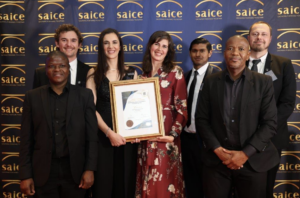
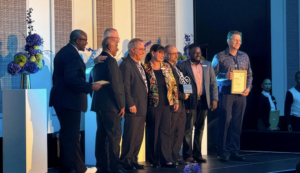
Back row: H.E. Mr Vusimuzi Madonsela, Honourable Samantha Graham-Maré, Peng Chaocai, and Dr. Huang Xiang.
This landmark electrolyser supply agreement supports the first tranche of a planned 800MW electro-Sustainable Aviation Fuel (eSAF) production project at Saldanha Bay, which marks the beginning of a globally competitive eSAF platform here in South Africa.
High-level commitment
The agreement was signed by Blair Phelan, Managing Director of Phelan Green Group, and Peng Chaocai, Vice President of Sungrow and Chairman of Sungrow Hydrogen. The signing ceremony was attended by the Honourable Samantha Graham-Maré, Deputy Minister of Electricity and Energy of the Republic of South Africa, and H.E. Mr Vusimuzi Madonsela, South African Ambassador to the Kingdom of the Netherlands. Their attendance underscored the strategic significance of the agreement, alongside senior representatives of both companies and project stakeholders.
The agreement builds on the South African Government’s 2023 designation of the Phelan Green Hydrogen platform as a Strategic Integrated Project (SIP), supporting accelerated infrastructure development for what is planned to become one of the country’s largest green hydrogen and derivative fuel investments.
The project is expected to drive regional economic activity, job creation and export revenue over the coming decade.
“Signing the largest electrolyser order ever placed on the African continent is a defining moment for our Group and for the South African green-fuels industry,” says Blair Phelan, Managing Director of Phelan Green Group. “Sungrow Hydrogen is one of the leading electrolyser manufacturers in the world, and their technology gives us the scale, efficiency and delivery certainty we need to take our 800 MW for the company’s flagship electro-Sustainable Aviation Fuel project at Saldanha Bay through to construction in September this year.”
Strong demand for eSAF
eSAF, often referred to as ‘green aviation fuel’, is regarded as one of the few scalable long-term pathways for the aviation sector’s transition toward lower-carbon aviation fuel alternatives.
Demand is being accelerated by the European Union’s ReFuelEU Aviation regulation and Germany’s Sustainable Aviation Fuel (SAF) mandates, which require fuel suppliers to blend increasing volumes of lower-carbon aviation fuel into conventional jet fuel or face significant financial penalties for non-compliance.
eSAF is produced using renewable electricity to power electrolysers that split water into hydrogen and oxygen through an electrochemical process. This green hydrogen is then combined with captured biogenic carbon dioxide (CO₂) and processed using thermochemical reactions. This turns the two gases into synthetic liquid hydrocarbons that can be used as a replacement for conventional jet fuel.
Positioning South Africa in the emerging global eSAF export market
As European demand for mandated eSAF continues to grow, South Africa has an opportunity to contribute meaningful new supply and become a competitive export partner for regulated aviation markets. Phelan Green Group’s Saldanha Bay eSAF project is being developed specifically for export into the European Union and other regulated aviation markets.
The project is intended to leverage South Africa’s renewable energy sources, port infrastructure and large-scale project sites. For example, lower-cost renewable electricity generation will reduce green hydrogen and eSAF production costs.
With these competitive advantages, as well as Saldanha Bay’s deep-water port infrastructure and Special Economic Zone status, South Africa is well positioned to become a reliable large-scale exporter of synthetic aviation fuels.
Fired up for the future
“The growing European interest in securing future eSAF supply from stable export partners is further underscored by our final-stage offtake negotiations with two major UK and EU refineries,” concludes Phelan. “It is expected that the Saldanha Bay eSAF project will produce 35,000 tons of eSAF for export to EU and other regulated markets per year.
“In addition, at the European Union’s 2030 synthetic aviation fuel mandate level, we project that the Saldanha Bay facility could eventually supply approximately 6% of projected EU eSAF demand for fuel uplifted at EU airports – positioning South Africa as a strategic production hub for eSAF.”
__________________________________________________________________________________
Ends
Statements:
Peng Chaocai, Vice President of Sungrow and Chairman of Sungrow Hydrogen, said:
“We sincerely appreciate the trust and strong support shown in signing this cooperation agreement. This marks an exciting new chapter in our partnership and a strong foundation for mutually beneficial cooperation. We remain committed to delivering on our promises, providing high-quality support and working closely together towards shared success and a bright future.
We also extend our sincere thanks to the Honourable Minister of Electricity and Energy for witnessing the signing ceremony. We greatly value the continued trust and support shown by all stakeholders as this cooperation begins a new journey. Together, we look forward to advancing energy development and building a stronger, more sustainable future.”
The Honourable Samantha Graham-Maré, Deputy Minister of Electricity and Energy, said:
“What is encouraging is the level of collaboration between government, developers, financial institutions and technology providers. Partnerships like these are essential to turning South Africa’s energy transition ambitions into practical, large-scale implementation.”